Age and fertility. What are the chances of getting pregnant at different ages?
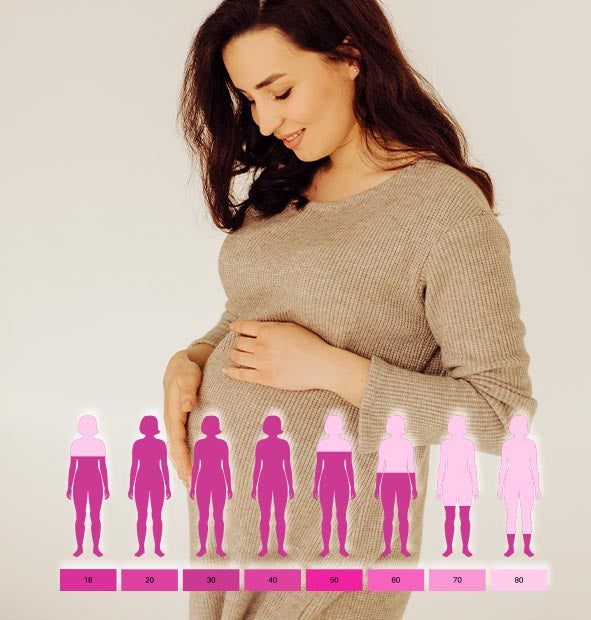
Age and fertility are closely linked. These are your chances of becoming pregnant at different stages of your life.
What are the chances of becoming pregnant?
Your chances of becoming pregnant depend mainly on your age. If you are in your 20s or early 30s, the odds are good that you will become pregnant within six months of starting your TTC (trying to conceive) journey.
“For healthy couples in their 20s and early 30s, about 1 in 4 women will become pregnant in any given menstrual cycle,” says the American College of Obstetricians and Gynecologists (ACOG). The American Society for Reproductive Medicine (ASRM) estimates that about 80% of women will become pregnant within the first six months of trying.
The chances of becoming pregnant decrease as a woman gets older, especially after age 35. Once you reach that birthday, your odds fall along with the number and quality of your eggs. At age 40, women have a 5% to 10% chance of becoming pregnant in any given menstrual cycle.
There are many possible reasons for age-related fertility decline, but the main reason is that you have fewer eggs and a higher percentage of abnormal eggs as you get older.
Surprisingly, you have the largest number of eggs available when you are still a fetus in your mother’s womb: at 20 weeks, female fetuses have up to 6 or 7 million follicles containing eggs in their ovaries. At birth, the number is around one million, and by puberty, the number of eggs drops to around 300,000.
At age 37, you have around 25,000 eggs, and by age 51 (the average age of menopause), you will have only around 1,000 eggs. Throughout your menstrual cycle, ovulation will use some of your egg-containing follicles, but most will be lost through a natural degenerative process called atresia.
Your eggs also decline in quality as you get older. This means that the remaining eggs are more likely to have abnormal chromosomes. This can prevent pregnancy, cause miscarriage, or lead to genetic problems such as Down syndrome.
Also, as you get older, you are more likely to have developed conditions—such as endometriosis and uterine fibroids—that can affect your fertility.
However, it is not all bad news and gloom for future mothers. Although eggs age, the uterus is often completely healthy and capable of carrying a pregnancy.
"A woman can still carry a pregnancy at an older age, especially if she froze her eggs or embryos earlier," says Sasha Hakman, M.D., a board-certified ob-gyn and reproductive endocrinologist specializing in infertility treatment at HRC Fertility in Los Angeles.
“Women who plan to become pregnant at an older age are at a higher risk of pregnancy complications, but with the right medical examination, they can continue to have a healthy pregnancy,” says Dr. Hakman.
Fertility by age
Here is a summary of how fertility changes over the years. Estimates vary (sometimes greatly) depending on the source. The data on the chances of pregnancy within 6 and 12 menstrual cycles are from a study published in the American Journal of Obstetrics and Gynecology involving nearly 3,000 couples with no history of infertility.
In your 20s
The chances are around 25% that you will become pregnant in any given menstrual cycle if you are trying to conceive in your early 20s, according to ACOG.
Women between the ages of 21 and 24 have a 57% chance of becoming pregnant within 6 menstrual cycles and a 71% chance of pregnancy within 12 cycles.
Women between the ages of 25 and 27 have a 59% chance of becoming pregnant within 6 cycles and a 79% chance of pregnancy within 12 cycles.
Between 28 and 30, the chances are 62% within 6 cycles and 78% within 12 cycles.
In your early 30s
At age 30, you have about a 20% chance of becoming pregnant each month you try, according to ASRM. But starting at age 32, ACOG says, fertility gradually declines, but noticeably.
From age 31 to 33, you have a 61% chance of pregnancy within 6 cycles and a 77% chance within 12 cycles.
From your mid-30s to late 30s
Fertility declines more quickly after you are in your mid-30s and, according to ACOG, drops rapidly after age 37.
Women who are 34 to 36 have a 56% chance of pregnancy within 6 cycles and a 75% chance within 12 cycles. Those who are 37 to 39 have a 46% chance within 6 cycles and a 67% chance within 12 cycles.
In your early 40s
By age 40, about 1 in 10 women will become pregnant in any given menstrual cycle, ACOG says. According to ASRM, your chance of pregnancy at age 40 is less than 5% per cycle.
Women aged 40 to 45 have 60% fewer chances of becoming pregnant in any given cycle than women in their early 20s. But it is possible: women in their early 40s have a 28% chance of pregnancy within 6 cycles and a 56% chance within 12 cycles.
From your mid-40s to late 40s
"By 45, fertility has declined so much that there is no chance of becoming pregnant naturally," ACOG says.
Keep in mind that even if you have not yet reached menopause, you may not yet be able to become pregnant.
Women do not remain fertile until menopause. “The average age of menopause is 51, but most women cannot have a successful pregnancy.